|
Relationships
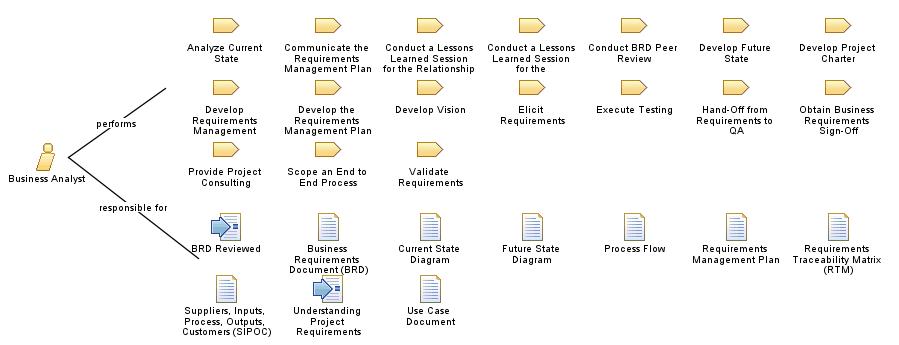
|
| Additionally Performs |
|
| Modifies |
|
Main Description
| A business analyst must analyze and synthesize information provided by a large number of people who interact with the
business, such as customers, staff, IT professionals, and executives. The business analyst is responsible for eliciting the
actual needs of stakeholders, not simply their expressed desires. In many cases, the business analyst will also work to
facilitate communication between organizational units. In particular, the business analyst often plays a central role in
aligning the needs of business units with the capabilities delivered by information technology, and may serve as a
“translator” between those groups. |
Staffing
| Skills |
A person performing this role needs the following:
-
Excellent communication skills
-
Analytical thinking skills
-
Problem solving skills
-
Process mapping skills
-
Organizational skills
-
Knowledge of software development life cycle
-
Ability to multi-task
-
Interpersonal skills
|
| Assignment Approaches | This role can be assigned in the following ways:
-
One (or more) team member performs this role exclusively. This commonly adopted approach is suitable for complex
requirements that are difficult to gather.
-
One (or more) team members performs both this role and tests the software. This is a good option for smaller test
teams or resource-constrained test teams.
-
A customer representative performs this role. This approach is suitable to agile teams where the customer is
available and is part of the team.
|
Version and Release
Unified Life Cycle (ULC): 5.1, November 3, 2014
Phase Gates: 1.1, May 27, 2014
Process Engineering Process (PEP): 1.1, May 27, 2014
|
|

