Throughout the software industry there are a lot of great ideas and knowledge available about how to effectively
develop software. Nowadays, development teams need and have access to a wide range of information. Not only do they
need to acquire detailed information about specific development technologies such as Java, Java EE, Eclipse, SOA
technologies, .NET, as well as various development and tool environments, but they also need to figure out how to
organize their work along modern development best practices such as agile, iterative, architecture-centric, risk- and
quality-driven software
development.
Some problems development organizations face when they leave their developers to find such information for
themselves
are:
-
team members will not have centralized and easy access to the same body of information when they need it, i.e.,
different developers might rely on different sources and versions of the same information;
-
it is difficult to combine and integrate content and development processes that are made available in their own
proprietary format, as every book and publication presents method content and process using a different
representation and presentation style;
-
it is hard to define an organized and systematic development approach that is right-sized to their needs, i.e.,
addresses their specific culture, standardized practices, and compliance requirements.
The Software and Systems Process Engineering Meta-model (SPEM) is a process engineering meta-model as well as
conceptual framework, which can provide the necessary concepts for modeling, documenting, presenting, managing,
interchanging, and enacting development methods and processes. An implementation of this meta-model would be targeted
at process engineers, project leads, project and program managers who are responsible for maintaining and implementing
processes for their development organizations or individual projects.
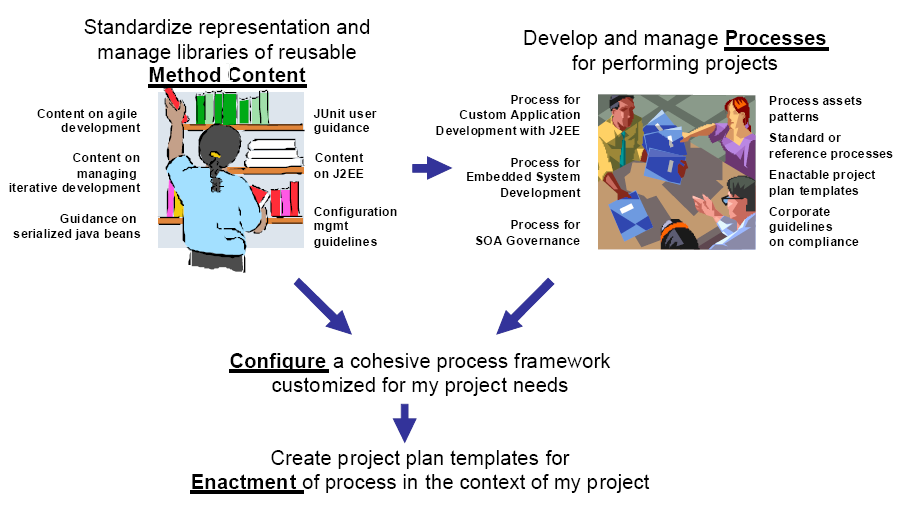
[The figure above] presents a conceptual framework for the usage of a SPEM 2.0 implementation:
-
To provide a standardized representation and managed libraries of reusable method content: Developers need to
understand the methods and key practices of software development. They need to be familiar with the basic
development tasks, such as how to elicit and manage requirements, how to do analysis and design, how to
implement for a design or for a test case, how to test implementations against requirements, how to manage the
project scope and change, and so on. They further need to understand the work products such tasks create as
well as which skills are required. SPEM 2.0 aims to support development practitioners in setting-up a knowledge
base of intellectual capital for software and systems development that would allow them to manage and deploy
their content using a standardized format. Such content could be licensed, acquired, and, more importantly,
their own homegrown content consisting of, for example, method definitions, whitepapers, guidelines, templates,
principles, best practices, internal procedures and regulations, training material, and any other general
descriptions of how to develop software. This knowledge base can be used for reference and education and forms
the basis for developing processes (see the next bullet point).
-
To support systematic development, management, and growth of development processes: Development teams need to
define how to apply their development methods and best practices throughout a project lifecycle. In other
words, they need to define or select a development process. For example, requirements management methods have
to be applied in one fashion during the early phases of a project, where the focus is more on elicitation of
stakeholder needs and requirements and scoping a vision. The same methods have to be performed in a different
fashion during later phases, where the focus is on managing requirements updates and changes and performing
impact analysis of these requirements changes. The same requirements methods might also be applied differently
if the project develops a new system or maintains an existing system as well as depending on the teams and
distribution of the teams. A development process model needs to support expressing these differences. Teams
also need a clear understanding of how the different tasks within the methods relate to each other: for
example, how the change management method impacts the requirements management method as well as the regression
testing method through out the lifecycle. SPEM 2.0 supports the systematic creation of processes based on
reusable method content. Lifecycle independent method content can be placed into a process for a specific
development lifecycle. Such processes can be represented as workflows and/or breakdown structures. Within these
process the reused method content can then be refined for its specific context. SPEM 2.0 also provides the
conceptual foundation for process engineers and project managers for selecting, tailoring, and rapidly
assembling processes for their concrete development projects. The vision for SPEM 2.0 is that vendors can sell
with their SPEM 2.0 implementation catalogs of pre-defined processes for typical project situations that can be
adapted to individual needs. Within these catalogs, the implementation could offer process building blocks or
process patterns that represent references processes for specific disciplines, technologies, or development
styles. These process patterns could form a toolkit for quickly assembling processes based on project specific
needs.
-
To support deployment of just the method content and process needed by defining configurations of processes and
method content: No development project is exactly like another and the same development process is never
executed twice. Reference frameworks for development processes such as CMMI define different levels of maturity
for processes. Each level entails different characteristics for the process definition as well as enactment in
an organization or project for each level. For example, CMMI defines a “managed process” as performed
activities that can be recognized as implementations of development practices. Such a process has certain
characteristics: it is planned and executed in accordance with policies; it employs skilled people, having
adequate resources to produce controlled outputs; it involves relevant stakeholders; it is monitored,
controlled, and reviewed; and it is evaluated for adherence to its process description. By contrast, a “defined
process” is a managed process that is tailored from the organization’s set of standard processes according to
the organization’s tailoring guidelines. A defined process has a maintained process description and contributes
work products, measures, and other process-improvement information to the organizational process assets. The
notions of Activity Use, Configurability, and Variability for development processes (as well as method content)
in SPEM 2.0 exactly address the needs for defined processes. These concepts provide capabilities for reuse of
processes or process patterns, for modeling variability (i.e., processes that comprise of configurable
alternative parts) and for tailoring allowing users to define their own extensions, omissions, and variability
points on reused standard processes. Hence, the SPEM usage scenario is that organizations can provide libraries
of reusable process and method using the capabilities describes in the first two bullet points. Team leads can
then select and tailor the method content and processes that they require. They can then describe these
selections and customizations with a SPEM Method Configuration, which they can deploy to their teams, only
providing the content they really need.
-
To support the enactment of a process for development projects: A process definition only provides value if it
impacts and steers development teams’ behavior. Processes as well as guiding method content need to be
available in the context of daily work of project managers, technical leads, and developers. They therefore
need to be deployed in formats that are ready for enactment with the process enactment systems of the team’s
choice. Typical enactment systems are project and resource planning systems, work backlog tracking systems, and
workflow engines. SPEM 2.0 provides process definition structures that allow process engineers to express how a
process shall be enacted within these systems. For example, SPEM 2.0 process definition can include information
that indicates that modeled work definitions shall be repeated several times in a project (modeling iterations)
or that there could be multiple occurrences of work definitions that can be performed in parallel.
Although, the SPEM 2.0 meta-model has been designed around the support for this framework, many other usage scenarios
could be realized as well. For example, Chapter 2 defines different compliance points and discusses different
implementation scenarios that might realize a variation of the scenarios depicted in [the figure above].
|

